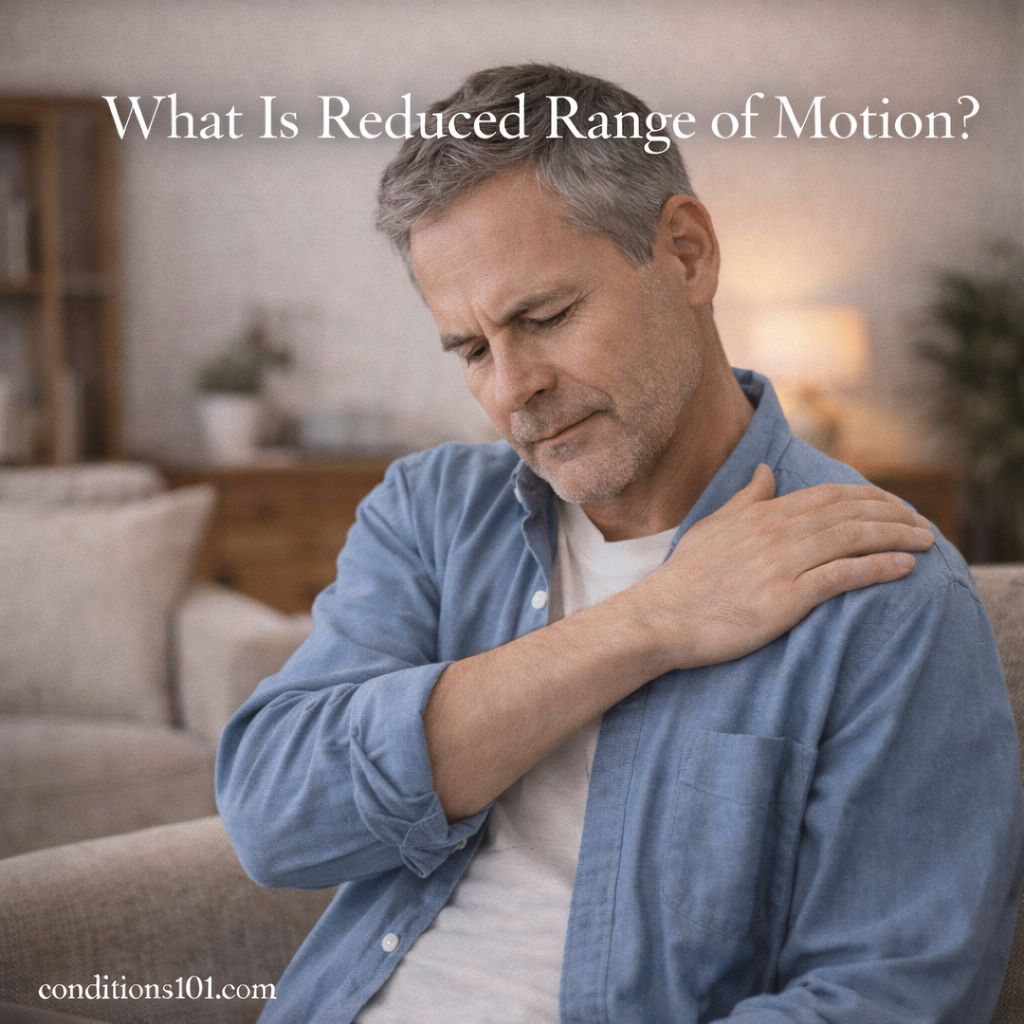
Reduced range of motion refers to a limitation in how far a joint or body part can move compared to what is considered typical. This limitation may affect flexibility, mobility, or the ability to perform everyday movements comfortably.
Reduced range of motion is not a medical diagnosis. It is a descriptive term used to explain changes in movement capacity rather than a specific condition or disease.
Understanding Range of Motion
Range of motion describes the extent to which a joint can move in different directions. This movement may include bending, straightening, rotating, or lifting, depending on the joint involved.
Examples of common joint movements include:
- Bending and straightening the knee
- Raising and lowering the shoulder
- Turning the neck side to side
- Flexing and extending the wrist
Each joint has a natural range that allows for daily activities and functional movement.
What Happens When Range of Motion Is Reduced
When range of motion is reduced, movements may feel limited, stiff, or restricted. The joint may not move as far or as smoothly as it once did.
Reduced range of motion can involve:
- Difficulty reaching or bending
- A feeling of tightness or stiffness
- Resistance during movement
- Compensating with other body parts
The experience can vary depending on which joint is affected and the individual’s overall mobility.
Common Areas Affected by Reduced Range of Motion
Reduced range of motion can occur in any joint but is more commonly noticed in areas that are used frequently or support weight.
These areas include:
- Shoulders
- Knees
- Hips
- Neck
- Lower back
- Ankles
Limitations in these areas may influence posture, balance, or daily routines.
Factors That Can Contribute to Reduced Range of Motion

Many factors can influence how freely a joint moves. Reduced range of motion often develops gradually rather than suddenly.
Common contributing factors include:
- Muscle tightness
- Joint stiffness
- Prolonged inactivity
- Repetitive movement patterns
- Aging-related changes
- Previous strain or injury
In many cases, more than one factor is involved.
Reduced Range of Motion vs. Temporary Stiffness
Reduced range of motion is different from short-term stiffness that improves quickly with movement.
Temporary stiffness
Often occurs after sitting, sleeping, or inactivity and usually eases once movement resumes.
Reduced range of motion
Refers to a more persistent limitation that does not resolve immediately with light activity.
The distinction often depends on duration, consistency, and impact on movement.
How Reduced Range of Motion Can Affect Daily Life
Limited movement can influence how easily everyday tasks are performed.
Activities that may feel more difficult include:
- Reaching overhead
- Getting dressed
- Walking up or down stairs
- Turning the head while driving
- Sitting or standing for extended periods
People may adapt their movements over time without consciously noticing the change.
Is Reduced Range of Motion Always a Problem?
Not always. Some changes in range of motion are mild and do not interfere significantly with daily activities. Others may be more noticeable depending on lifestyle, physical demands, or individual movement needs.
Reduced range of motion may fluctuate, improve, or stabilize depending on circumstances.
Common Misconceptions About Reduced Range of Motion
There are several misunderstandings about reduced range of motion.
- It does not always indicate serious injury
- Mild limitations are common with aging
- Reduced movement is not always permanent
- It can affect one joint without affecting others
Understanding these points helps place movement changes in context.
Why Reduced Range of Motion Is Discussed
Reduced range of motion is commonly discussed because movement plays a key role in independence, comfort, and quality of life. Educational information helps explain why mobility may change over time without assuming a specific condition or outcome.
Learning how range of motion works can make physical health terms easier to understand.
Key Takeaways
- Reduced range of motion means limited movement in a joint or body part
- It is a descriptive term, not a medical diagnosis
- Many factors can influence movement flexibility
- It can affect daily activities to varying degrees
- Changes in range of motion may be temporary or long-term