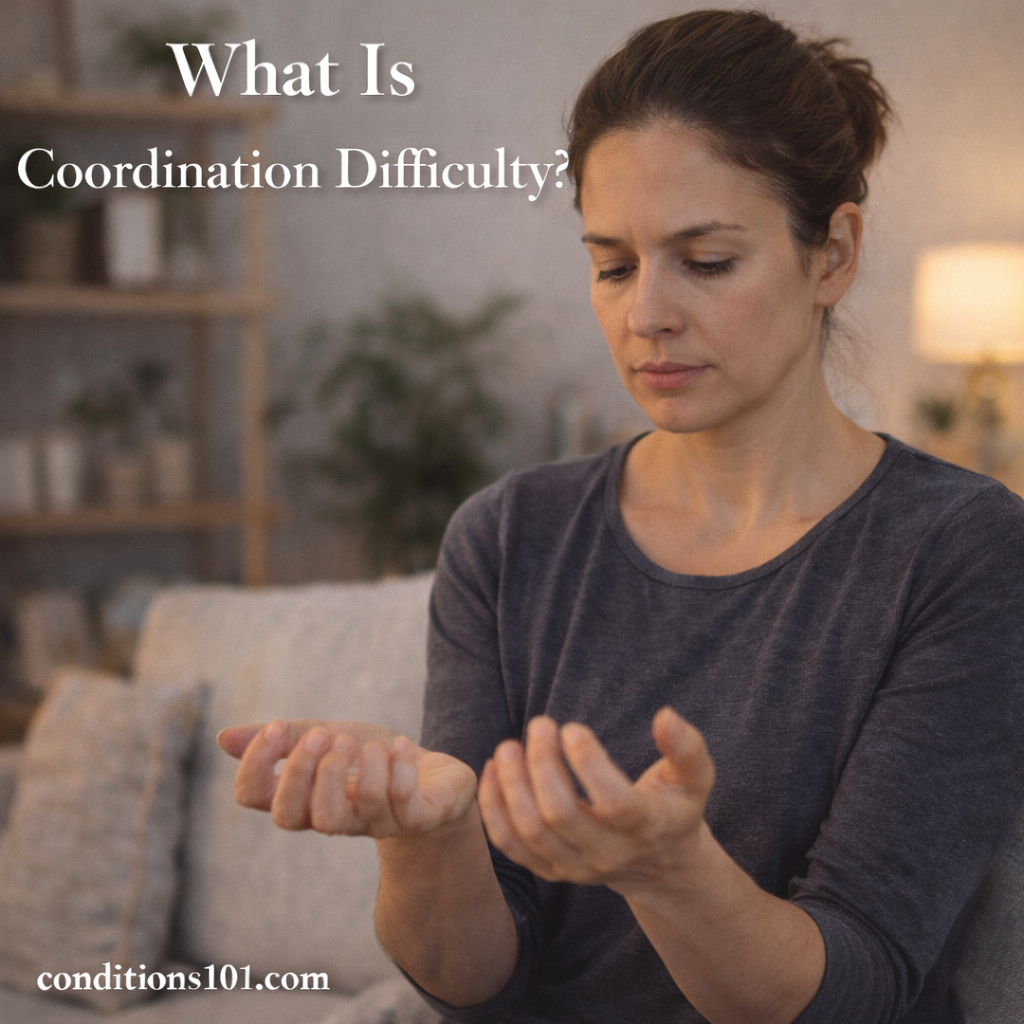
Coordination difficulty refers to challenges with smoothly controlling movements of the body. It can involve trouble with balance, timing, precision, or the ability to perform tasks that require multiple muscles or body parts to work together. Coordination difficulty may affect fine motor skills, gross motor skills, or both.
This article provides a clear, educational overview of what coordination difficulty is. It is intended for general information only and does not offer medical advice, diagnosis, or treatment.
Understanding Coordination
Coordination is the ability of the nervous system and muscles to work together to produce controlled, purposeful movement. Everyday activities such as walking, writing, typing, catching an object, or maintaining balance rely on coordination.
When coordination is affected, movements may feel awkward, unsteady, slower than expected, or less precise.
What Does Coordination Difficulty Mean?
Coordination difficulty is a broad, descriptive term rather than a specific diagnosis. It is often used to describe situations where movements do not feel as controlled or synchronized as usual.
People experiencing coordination difficulty may notice:
- Clumsiness or frequent dropping of objects
- Difficulty with balance or stability
- Trouble with tasks requiring precise hand movements
- Movements that feel shaky, delayed, or poorly timed
The severity and pattern of these difficulties can vary widely.
Types of Coordination Difficulty

Coordination challenges can affect different kinds of movement.
Fine Motor Coordination
Fine motor coordination involves small, precise movements, usually of the hands and fingers.
Examples include:
- Writing or drawing
- Buttoning clothing
- Using utensils
- Typing on a keyboard
Gross Motor Coordination
Gross motor coordination involves larger body movements that use major muscle groups.
Examples include:
- Walking or running
- Maintaining balance
- Climbing stairs
- Catching or throwing objects
Some people experience difficulty mainly in one area, while others notice challenges in both.
Common Factors Associated With Coordination Difficulty
Coordination difficulty can be influenced by a variety of factors and situations.
Fatigue or Low Energy
Tiredness can affect how efficiently the brain and muscles communicate, leading to less controlled movement.
Stress and Mental Load
High levels of stress or mental distraction may interfere with focus and movement control.
Sensory Input Changes
Coordination relies on information from the senses, such as vision and body awareness. Changes in sensory input can affect movement accuracy.
Developmental or Age-Related Changes
Coordination skills develop over time and may also change gradually with aging, influencing balance and precision.
Common Signs and Experiences
People with coordination difficulty may describe a range of everyday experiences.
These may include:
- Feeling unsteady or off-balance
- Slower reaction times
- Difficulty learning new physical tasks
- Increased effort needed to complete routine movements
These experiences may be occasional or more consistent, depending on the individual.
How Coordination Difficulty Can Affect Daily Life
Coordination challenges can influence daily routines in subtle or noticeable ways.
Examples include:
- Taking longer to complete tasks
- Avoiding activities that feel physically challenging
- Feeling frustrated with physical performance
- Needing extra concentration to move safely or accurately
The level of impact often depends on how frequently coordination difficulties occur and which activities are affected.
Coordination Difficulty vs. Muscle Weakness
Coordination difficulty is different from muscle weakness. Muscle weakness involves reduced strength, while coordination difficulty involves how well movements are controlled and timed.
A person may have normal muscle strength but still experience coordination challenges due to issues with movement control rather than force.
Can Coordination Difficulty Change Over Time?
Yes. Coordination difficulty may be temporary or fluctuate depending on factors such as fatigue, stress, environment, or routine changes. In other cases, it may remain consistent or change gradually over time.
Key Takeaways About Coordination Difficulty
- Coordination difficulty involves challenges with controlled movement
- It can affect fine motor skills, gross motor skills, or both
- It is a descriptive term rather than a specific diagnosis
- Many factors can influence coordination, including fatigue and stress
- Experiences and impact vary widely between individuals