Brain Fog vs Memory Loss: What’s the Difference?

Adult woman sitting indoors with a thoughtful expression, representing an educational comparison between brain fog and memory loss.
A reflective moment highlighting differences in focus and recall during everyday thinking. conditions101.com.

Brain fog and memory loss are terms people often use interchangeably, but they describe different cognitive experiences. Both can affect thinking and daily functioning, yet they differ in how they feel, how they show up, and what aspects of cognition they involve.

Understanding the distinction can help clarify what someone is experiencing and avoid unnecessary confusion or worry.

Continue reading “Brain Fog vs Memory Loss: What’s the Difference?”
What Is Chronic Lightheadedness?

Adult man sitting calmly indoors with his hand resting on his head, representing an educational article about chronic lightheadedness.
A thoughtful moment reflecting the experience of ongoing lightheadedness in everyday life. conditions101.com.

Chronic lightheadedness refers to a persistent or frequently recurring sensation of feeling faint, unsteady, or mentally “light” that lasts over an extended period of time. Unlike brief or occasional lightheadedness that may happen after standing up quickly or skipping a meal, chronic lightheadedness tends to linger or return regularly.

This experience is often described as feeling off-balance, foggy, or as if one might faint—without actually losing consciousness.

Continue reading “What Is Chronic Lightheadedness?”

What Is Brain-Body Communication?

Adult woman sitting calmly on a couch in a home setting, representing an educational article about brain-body communication.
A thoughtful moment illustrating the connection between the brain and body in everyday life. conditions101.com.

Brain-body communication refers to the continuous exchange of signals between the brain and the rest of the body that allows movement, sensation, regulation, and awareness to function together. This communication helps coordinate how the body responds to internal needs and external environments in real time.

Rather than operating separately, the brain and body function as an integrated system, constantly sending and receiving information to maintain balance and support daily activities.

Continue reading “What Is Brain-Body Communication?”

What Is Hormone Signaling?

Adult man sitting calmly in a living room, representing an educational article explaining hormone signaling.
A calm, reflective moment illustrating how the body communicates through hormone signaling. conditions101.com.

Hormone signaling is the process by which hormones act as chemical messengers in the body, carrying information from one group of cells to another. These signals help coordinate and regulate many essential functions, including growth, metabolism, mood, reproduction, and energy balance.

Hormone signaling allows different organs and systems to communicate with each other efficiently, even when they are far apart.

Continue reading “What Is Hormone Signaling?”

What Is Sleep Resilience?

Adult woman sitting calmly in a living room, representing an educational article explaining the concept of sleep resilience.
A reflective moment in a calm home setting, illustrating adaptability and balance in everyday sleep patterns. conditions101.com.

Sleep resilience refers to the body’s and mind’s ability to maintain, recover, or adapt healthy sleep patterns despite disruptions such as stress, schedule changes, poor sleep nights, or environmental challenges. Rather than meaning “perfect sleep,” sleep resilience describes how well someone can bounce back after sleep disturbances.

People with strong sleep resilience may still experience occasional poor sleep, but their overall sleep quality tends to stabilize over time without prolonged disruption.

Continue reading “What Is Sleep Resilience?”

What Is Tension Pain?

Adult man sitting in a living room with his hand on his neck, illustrating an educational article about tension pain.
A calm moment of reflection highlighting common muscle tension in everyday life. conditions101.com.

Tension pain is a type of physical discomfort commonly described as a feeling of tightness, pressure, or dull aching in the body. It often develops gradually and is usually linked to muscle tension, posture, repetitive movement, or prolonged physical or mental strain.

Tension pain is widespread and can affect people of all ages. It is typically non-sharp and non-sudden, and many people recognize it as a familiar, everyday form of discomfort.

Continue reading “What Is Tension Pain?”

What Is Fullness After Eating?

Adult woman sitting calmly in a living room with her hand on her abdomen, representing an educational article about fullness after eating.
A calm moment after a meal, illustrating the normal sensation of fullness during digestion. conditions101.com.

Fullness after eating is a common digestive sensation that occurs when the stomach feels satisfied, heavy, or comfortably filled following a meal. It is a normal part of digestion and signals that the body has received enough food to begin processing nutrients.

For most people, fullness develops gradually during or shortly after eating and fades as digestion continues. The intensity and duration of fullness can vary depending on what was eaten, how much was consumed, and individual digestive patterns.

Continue reading “What Is Fullness After Eating?”

What Is Razor Burn?

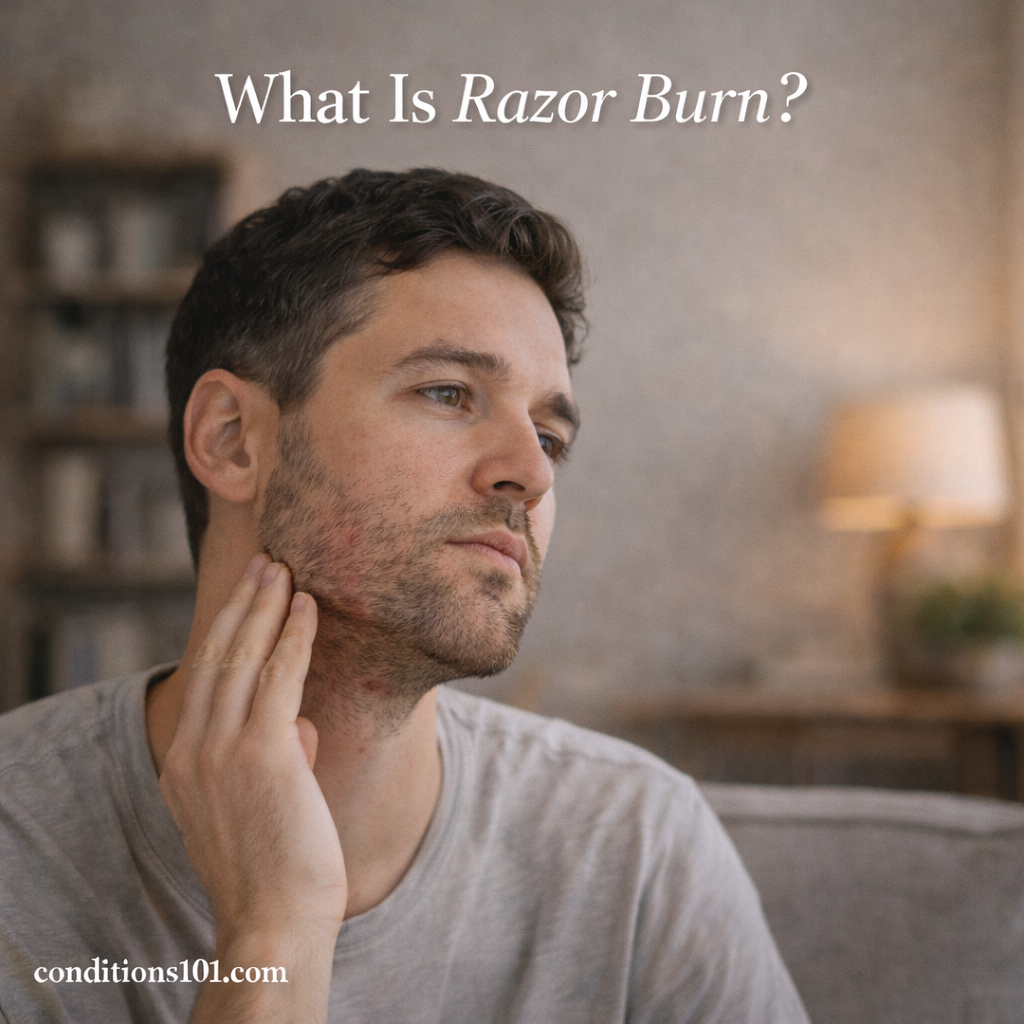
Adult man touching his neck in a calm home setting, representing an educational article explaining what razor burn is.
An adult reflecting on skin irritation in a relaxed home environment. conditions101.com.

Razor burn is a common skin reaction that occurs after shaving, resulting in irritation, redness, or discomfort on the skin. It is typically caused by friction, pressure, or sensitivity during the shaving process rather than by an underlying skin disease.

Razor burn is temporary and surface-level, affecting the outer layer of the skin. It can appear anywhere shaving occurs, including the face, neck, legs, underarms, or other shaved areas.

Continue reading “What Is Razor Burn?”

What Is Depersonalization?

Adult man sitting calmly in a living room, representing an educational article explaining what depersonalization is.
An adult in a quiet home setting, reflecting during an educational overview of depersonalization. conditions101.com.

Depersonalization is a mental and cognitive experience in which a person feels detached from their own thoughts, feelings, body, or sense of self. People often describe it as feeling unreal, emotionally numb, or as though they are observing themselves from the outside.

Importantly, depersonalization affects perception, not reality. Individuals experiencing depersonalization typically remain aware that the feeling is unusual or distressing, even though it feels very real to them.

Continue reading “What Is Depersonalization?”

What Is a Chronic Condition?

Adult woman sitting calmly in a living room, representing an educational article about what a chronic condition is.
An adult reflecting in a calm home environment for an educational overview of chronic conditions. conditions101.com.

A chronic condition is a health-related condition that tends to be long-lasting and often requires ongoing management rather than short-term care. Unlike acute conditions, which typically develop suddenly and resolve within a short period of time, chronic conditions often persist for months, years, or even a lifetime.

Chronic conditions can affect people of all ages and may vary widely in how severe they are, how they progress, and how much they impact daily life. Some are relatively stable over time, while others may change or fluctuate.

Continue reading “What Is a Chronic Condition?”