Mood Changes vs Mood Disorders: What’s the Difference?

Adult woman sitting thoughtfully in a living room, representing the difference between normal mood changes and mood disorders.
A calm, everyday moment illustrating emotional reflection and normal mood variation. conditions101.com.

Mood changes and mood disorders both involve shifts in emotional state, but they are not the same thing. Mood changes are a normal part of human experience, while mood disorders are clinical categories used to describe persistent, disruptive patterns of emotional regulation.

Understanding the difference helps clarify when emotional shifts are part of everyday life versus when they represent a recognized mental health condition. This article is informational only and does not provide diagnosis, treatment, or medical advice.

Continue reading “Mood Changes vs Mood Disorders: What’s the Difference?”

What Is Idiopathic Pain?

Adult woman sitting calmly in a living room with a thoughtful expression, representing idiopathic pain in everyday life.
A quiet, everyday moment reflecting how pain can exist without a clearly identifiable cause. conditions101.com.

Idiopathic pain refers to pain that persists or recurs without a clearly identifiable cause, even after appropriate evaluation. The term “idiopathic” is used in medicine to describe symptoms or conditions that arise without a known origin. In this context, it means the source of the pain cannot be definitively explained by injury, disease, or structural abnormality.

Idiopathic pain is a descriptive label rather than a diagnosis. It acknowledges the presence of real pain while recognizing that current testing or understanding has not identified a specific underlying cause.

This article is educational and informational, focusing on how idiopathic pain is defined and understood, not on diagnosis or treatment.

Continue reading “What Is Idiopathic Pain?”

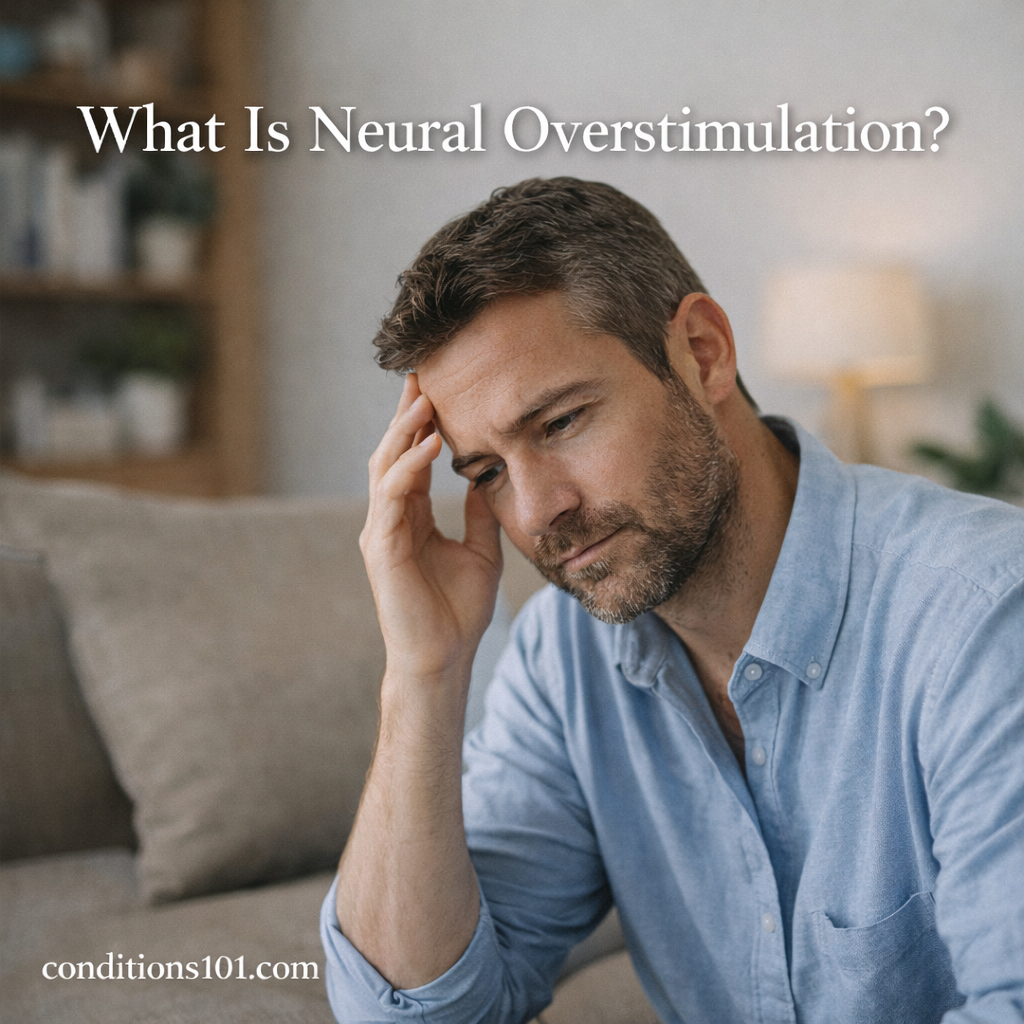
What Is Neural Overstimulation?

Adult man sitting quietly in a living room with a thoughtful expression, representing neural overstimulation in everyday life.
A calm, everyday moment illustrating how the nervous system processes continuous mental and sensory input. conditions101.com.

Neural overstimulation refers to a state in which the nervous system receives more sensory or cognitive input than it can efficiently process at a given time. This can occur when the brain is exposed to continuous, intense, or overlapping stimuli without sufficient opportunity to rest, filter, or reset.

The nervous system is designed to take in information from the environment, interpret it, and respond appropriately. Neural overstimulation happens when this input exceeds the system’s short-term processing capacity, leading to mental or sensory overload rather than effective response.

This concept is informational and descriptive, focusing on how the nervous system functions under high input conditions rather than on diagnosis or treatment.

Continue reading “What Is Neural Overstimulation?”

What Is Hormonal Stability?

Adult person sitting calmly in a living room, appearing thoughtful and relaxed, representing hormonal stability in everyday life.
A calm, everyday moment representing hormonal stability and internal balance. conditions101.com.

Hormonal stability refers to the body’s ability to regulate hormone levels in a consistent, balanced, and responsive way over time. Hormones are chemical messengers that travel through the bloodstream and help control many essential processes, including metabolism, energy regulation, mood, growth, sleep, and reproduction.

Hormonal stability does not mean hormone levels stay exactly the same at all times. Natural fluctuations occur daily and throughout life. Stability instead describes how effectively the body adjusts hormone production and signaling in response to changing conditions without prolonged disruption.

Understanding hormonal stability helps explain how the body maintains internal balance and coordinates complex systems automatically.

Continue reading “What Is Hormonal Stability?”

What Is Sleep Sensitivity?

Adult person sitting thoughtfully in a calm home environment, representing an educational article about sleep sensitivity.
A quiet, reflective moment illustrating how sleep sensitivity can influence everyday rest and awareness. conditions101.com.

Sleep sensitivity refers to how easily a person’s sleep is affected by internal or external factors. Someone with higher sleep sensitivity may notice that small changes—such as noise, light, stress, schedule shifts, or minor discomfort—have a noticeable impact on how easily they fall asleep, stay asleep, or feel rested afterward.

Sleep sensitivity is a descriptive concept rather than a diagnosis. It helps explain differences in how individuals respond to everyday sleep influences and why some people experience more disrupted or variable sleep than others under similar conditions.

Understanding sleep sensitivity can support clearer conversations about sleep patterns and expectations without implying a medical condition.

Continue reading “What Is Sleep Sensitivity?”

What Is Musculoskeletal Discomfort?

Adult person sitting in a calm home environment, representing an educational article about musculoskeletal discomfort.
A calm, everyday moment illustrating how musculoskeletal discomfort can be experienced during normal daily life. conditions101.com.

Musculoskeletal discomfort refers to sensations of unease, soreness, stiffness, or mild pain affecting the muscles, bones, joints, tendons, ligaments, or related soft tissues. It describes how the body feels rather than identifying a specific injury, disease, or diagnosis.

This type of discomfort is common and can occur in people of all ages. It often develops in response to everyday activities, physical strain, posture, repetitive movement, or temporary changes in routine. In many cases, musculoskeletal discomfort is short-lived and varies in intensity.

Understanding musculoskeletal discomfort helps provide clear language for describing physical sensations without implying a specific medical condition.

Continue reading “What Is Musculoskeletal Discomfort?”

What Is Early Satiety?

Adult person sitting at a dining table in a calm home environment, representing an educational article about early satiety.
A quiet mealtime moment illustrating how early satiety can affect eating experiences in everyday settings. conditions101.com.

Early satiety is a sensation of feeling full sooner than expected during a meal. A person experiencing early satiety may feel satisfied after eating only a small amount of food, even when they would normally eat more. This sensation occurs before the body’s usual fullness signals would typically appear.

Early satiety relates to how the digestive system processes food and how fullness signals are perceived. It is a descriptive term used to explain an eating-related experience rather than a diagnosis or treatment outcome.

Understanding early satiety can help people recognize changes in appetite patterns and better describe digestive sensations in everyday or educational contexts.

Continue reading “What Is Early Satiety?”

What Is Skin Redness?

Adult person sitting thoughtfully in a calm home environment, representing an educational article about skin redness.
A calm, everyday moment illustrating how skin redness can appear in normal, non-clinical settings. conditions101.com.

Skin redness refers to a visible change in skin color where areas appear pink, red, or flushed compared to the surrounding skin. This change occurs when blood flow near the surface of the skin increases, making blood vessels more noticeable. Skin redness can affect small patches or larger areas and may appear suddenly or develop gradually.

Skin redness is a common and often temporary appearance change. It can occur for many reasons, ranging from everyday environmental factors to short-term skin reactions. In many cases, it resolves on its own once the underlying trigger passes.

Understanding what skin redness is can help people better recognize normal skin responses and distinguish short-term changes from ongoing skin concerns.

Continue reading “What Is Skin Redness?”

What Is Derealization?

Adult person sitting thoughtfully in a calm home environment, representing an educational article about derealization.
A calm, reflective moment illustrating how derealization can affect perception in everyday settings. conditions101.com.

Derealization is a mental and perceptual experience in which the world around a person feels unreal, distant, or distorted. People experiencing derealization often describe their surroundings as foggy, flat, dreamlike, or visually altered, even though they know the environment has not actually changed.

This experience affects perception rather than reality itself. Objects, places, and people are still recognized correctly, but they may seem unfamiliar, artificial, or emotionally disconnected. Derealization is considered a perceptual and cognitive experience, not a loss of awareness or understanding.

Continue reading “What Is Derealization?”

What Is a Temporary Condition?

Adult person sitting thoughtfully in a calm home setting representing an educational article about temporary health conditions.
An everyday moment reflecting a thoughtful approach to understanding temporary health conditions. conditions101.com.

A temporary condition is a health-related issue that develops for a limited period of time and is expected to improve or resolve. Unlike long-term or chronic conditions, temporary conditions are not considered permanent and typically do not require ongoing management over many years.

These conditions are often linked to short-term triggers such as minor illnesses, physical strain, environmental factors, or normal life changes. Once the underlying cause passes or the body completes its recovery process, symptoms usually subside.

Understanding what a temporary condition is can help people better interpret health information, set realistic expectations, and communicate more clearly in everyday, educational, or workplace settings.

Continue reading “What Is a Temporary Condition?”