What Is Scalp Sensitivity?

Adult woman gently touching her scalp in a calm home setting, representing scalp sensitivity in everyday life.
An adult reflecting quietly at home, illustrating scalp sensitivity as an everyday comfort experience. conditions101.com.

Scalp sensitivity is a term used to describe discomfort, tenderness, or heightened reactivity of the scalp. People with a sensitive scalp may notice sensations such as tightness, tingling, burning, itching, or soreness, even when there are no visible skin changes.

Scalp sensitivity is not a diagnosis. It is a descriptive experience that can vary in intensity, frequency, and triggers. Some people notice it occasionally, while others experience it more consistently as part of their daily routine.

Continue reading “What Is Scalp Sensitivity?”

What Is Emotional Numbness?

Adult woman sitting indoors near a window with a calm, neutral expression, representing emotional numbness in everyday life.
An adult reflecting quietly in a calm home setting, illustrating emotional numbness in daily life. conditions101.com.

Emotional numbness is a term used to describe a reduced ability to feel or express emotions. People experiencing emotional numbness may feel disconnected from their feelings, surroundings, or even from other people. Emotions that once felt strong—such as joy, sadness, anger, or excitement—may feel muted, distant, or entirely absent.

Emotional numbness is not a diagnosis. It is a descriptive experience that can occur in many different contexts and at various points in life. The experience can be temporary or longer-lasting and may vary in intensity from person to person.

Continue reading “What Is Emotional Numbness?”

What Is Functional Limitation?

Adults sitting in a calm living room setting, thoughtfully focused in an everyday environment, representing functional limitation awareness.
Adults in a calm everyday setting reflecting on the concept of functional limitation. conditions101.com.

Functional limitation is a general term used to describe difficulty performing everyday activities because of physical, mental, sensory, or emotional challenges. These limitations can affect how a person moves, communicates, thinks, or carries out routine tasks at home, work, school, or in the community.

The concept focuses on what a person is able to do in daily life, rather than on a specific disease or medical diagnosis. Functional limitation can be temporary or long-term, mild or severe, and may change over time.

Continue reading “What Is Functional Limitation?”

Low Energy vs Chronic Fatigue: What’s the Difference?

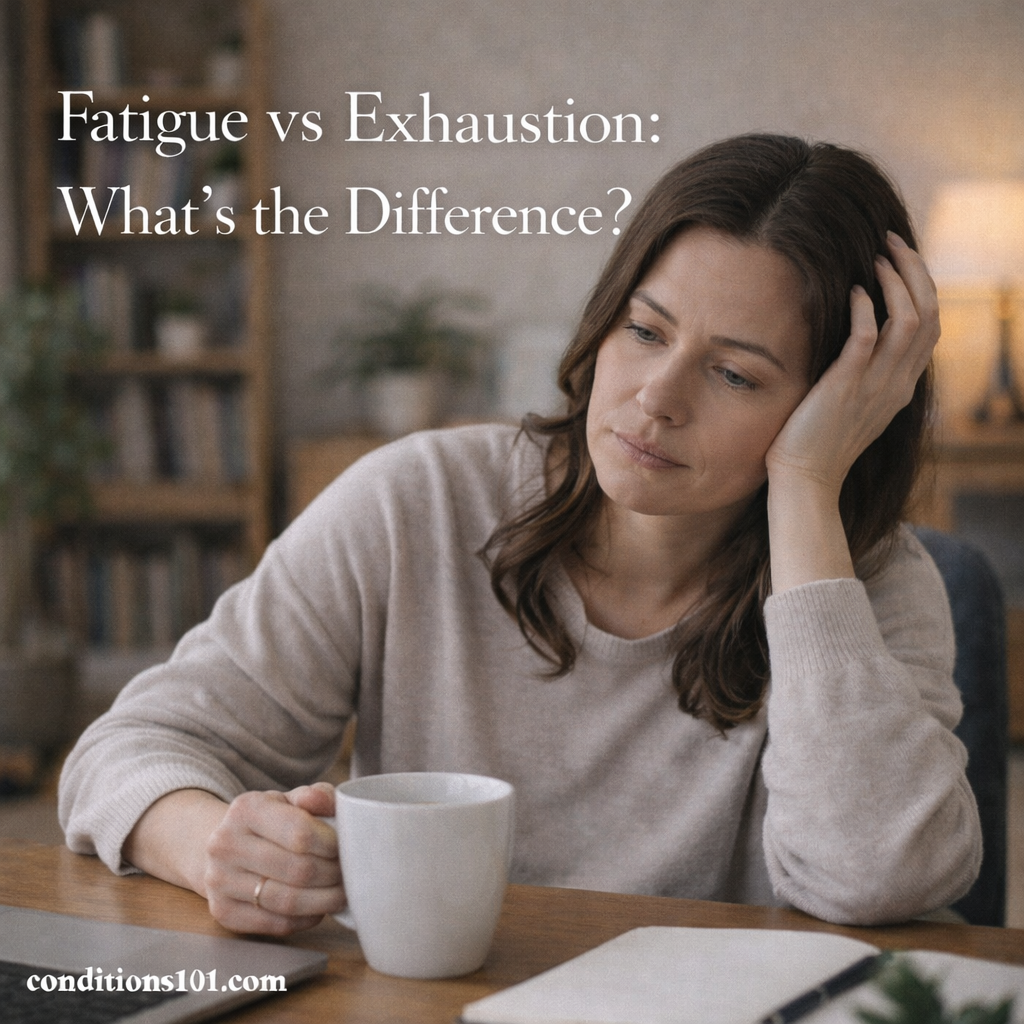
Adult person sitting in a calm home setting with a tired but neutral expression, representing low energy versus chronic fatigue in everyday life.
An adult person resting in a quiet home environment, illustrating everyday experiences related to low energy and chronic fatigue. conditions101.com.

Low energy and chronic fatigue are often used interchangeably in everyday conversation, but they describe different experiences. Both relate to feelings of tiredness or reduced capacity, yet they differ in duration, intensity, and how they affect daily life.

Understanding the distinction between low energy and chronic fatigue can help people describe their experiences more clearly and set realistic expectations about recovery and daily functioning.

Continue reading “Low Energy vs Chronic Fatigue: What’s the Difference?”

What Is Chronic Dry Eyes?

Adult person in a calm home setting gently touching their eye, representing chronic dry eyes as an ongoing, non-clinical eye comfort concern.
An adult person in a relaxed everyday environment, reflecting an educational and non-clinical perspective on chronic dry eyes. conditions101.com.

Chronic dry eyes refers to a long-lasting condition in which the eyes do not feel adequately lubricated or comfortable on a regular basis. Instead of being an occasional sensation, dryness may be noticed consistently or repeatedly over time.

Chronic dry eyes is commonly discussed in eye health education and awareness resources. It describes a pattern of ongoing eye discomfort rather than serving as a diagnosis or indicating a specific underlying disease.

Continue reading “What Is Chronic Dry Eyes?”

What Is Sensory Awareness?

Adult person seated outdoors in a calm public space, thoughtfully focused, representing sensory awareness in everyday life.
An adult person in a relaxed outdoor setting, reflecting an educational and non-clinical perspective on sensory awareness. conditions101.com.

Sensory awareness refers to the ability to notice, recognize, and interpret sensory information from the body and the surrounding environment. This includes awareness of sights, sounds, smells, tastes, touch, movement, and internal bodily sensations.

Sensory awareness is a descriptive concept used in neurological, sensory, and educational contexts. It helps explain how people perceive and respond to sensory input as part of everyday experience, rather than serving as a diagnosis or medical condition.

Continue reading “What Is Sensory Awareness?”

What Is Hormone Rhythm?

Adult person sitting in a calm home setting, thoughtfully focused, representing hormone rhythm as a natural timing pattern in everyday health.
An adult person in a relaxed home environment, reflecting an educational and non-clinical perspective on hormone rhythm. conditions101.com.

Hormone rhythm refers to the natural patterns and timing by which hormones are released and regulated in the body throughout the day, night, or longer cycles. Rather than being constant, many hormones rise and fall in predictable rhythms that help coordinate bodily functions such as energy levels, sleep, metabolism, and mood.

Hormone rhythm is commonly discussed in hormonal and metabolic health education. It is a descriptive concept that explains timing and patterns of hormone activity, not a medical diagnosis.

Continue reading “What Is Hormone Rhythm?”

What Is Sleep Stability?

Adult person sitting in a calm home setting, thoughtfully focused, representing sleep stability as a consistent and restful sleep concept.
An adult person in a relaxed home environment, reflecting an educational and non-clinical perspective on sleep stability. conditions101.com.

Sleep stability refers to how consistent, uninterrupted, and predictable a person’s sleep patterns are over time. It focuses on the regularity of sleep timing and the ability to maintain continuous sleep without frequent disruptions, rather than on how many hours of sleep a person gets.

Sleep stability is commonly discussed in sleep education and fatigue-related awareness contexts. It is a descriptive concept used to explain sleep patterns and experiences, not a medical diagnosis.

Continue reading “What Is Sleep Stability?”

What Is Localized Pain?

Adult person sitting in a calm home setting, gently holding their shoulder, representing localized pain in an everyday, non-clinical context.
An adult person in a relaxed home environment, illustrating how localized pain may be experienced in daily life. conditions101.com.

Localized pain refers to pain that is felt in a specific, clearly defined area of the body rather than spread across multiple regions. It is often described as pain that can be pointed to or easily identified by location, such as pain in the knee, shoulder, lower back, or a single joint.

Localized pain is a descriptive term used in pain education and general health discussions. It does not identify a cause or condition on its own, but instead explains how pain is experienced and where it is felt.

Continue reading “What Is Localized Pain?”

What Is Functional Digestive Disorder?

Adult person in a calm everyday setting, thoughtfully focused, representing functional digestive disorder as a non-clinical digestive health concept.
An adult person in a relaxed daily environment, reflecting an educational and non-clinical perspective on functional digestive disorders. conditions101.com.

A functional digestive disorder refers to a group of digestive conditions in which symptoms are present, but routine medical testing does not show clear structural or biochemical abnormalities. In simple terms, the digestive system appears normal in standard examinations, yet it does not function as expected.

Functional digestive disorders are commonly discussed in digestive health education and gut-related awareness resources. They describe how the digestive system behaves rather than identifying visible damage or disease.

Continue reading “What Is Functional Digestive Disorder?”