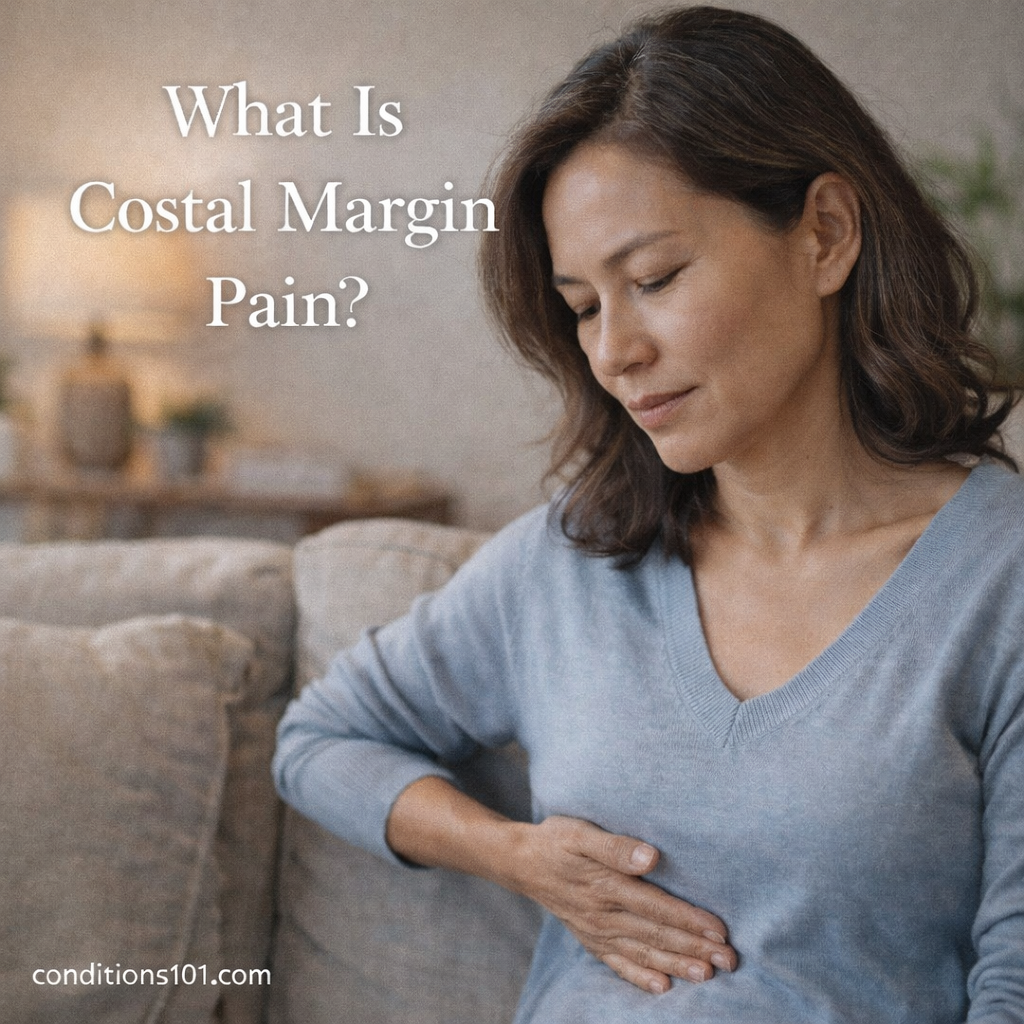
Costal margin pain refers to discomfort or tenderness felt along the lower edge of the rib cage, known as the costal margin. The costal margin is formed by the cartilage that connects the lower ribs to the sternum and helps support the structure of the chest.
In educational health contexts, costal margin pain is discussed as a symptom or experience rather than a specific diagnosis. It describes the location and type of pain, not its underlying cause.
Understanding the Costal Margin
The costal margin is the curved lower border of the rib cage. It plays an important role in:
- Protecting internal organs
- Supporting breathing mechanics
- Allowing flexibility of the chest wall
Because this area involves bones, cartilage, muscles, and connective tissue, discomfort in the costal margin can arise from several different sources.
How Costal Margin Pain Is Commonly Described
People may describe costal margin pain in different ways depending on the situation and contributing factors.
Common descriptions include:
- Sharp or stabbing discomfort
- Dull, aching soreness
- Tenderness when pressing on the area
- Pain that worsens with movement or deep breathing
- A sensation of tightness along the lower ribs
The pain may be felt on one side or both sides of the rib cage.
Where Costal Margin Pain Is Felt
Costal margin pain is typically located:
- Along the lower edge of the rib cage
- Near the front or sides of the chest
- Below the chest wall and above the upper abdomen
Because of its location, it may sometimes be confused with abdominal or upper back discomfort.
Situations Where Costal Margin Pain May Appear

Costal margin pain is often discussed in relation to everyday physical activities or posture-related strain.
It may be noticed during or after:
- Twisting or bending movements
- Lifting or reaching
- Prolonged sitting or poor posture
- Physical exertion
- Deep breathing, coughing, or sneezing
In some cases, the pain is temporary and linked to mechanical strain.
Musculoskeletal Factors
Educational discussions often highlight musculoskeletal factors when describing costal margin pain.
These may include:
- Muscle strain in the chest or upper abdomen
- Tension in the intercostal muscles between the ribs
- Irritation of rib cartilage
- Reduced flexibility of the chest wall
Because the rib cage moves with breathing and posture, strain in this area can be noticeable during normal daily activities.
Costal Margin Pain and Internal Sensations
Although costal margin pain is often musculoskeletal, its location can cause concern because it sits near vital organs. Educational materials emphasize that location alone does not indicate the source of pain.
Understanding the anatomical context helps explain why sensations in this area can feel unfamiliar or alarming even when related to surface structures.
How Costal Margin Pain Differs From Other Rib or Chest Pain
Costal margin pain is distinct from other chest or rib discomfort based on its position and behavior.
General distinctions include:
- Located at the lower rib edge rather than the center of the chest
- Often affected by movement or posture
- May be tender to touch
- Less likely to feel like pressure deep within the chest
These distinctions are descriptive and not diagnostic.
Variability in Experience
Costal margin pain can vary widely between individuals.
Differences may include:
- Intensity of discomfort
- Duration (brief vs persistent)
- One-sided or bilateral sensation
- Sensitivity to movement or touch
Some people notice it briefly, while others may experience recurring discomfort.
Why Costal Margin Pain Is Discussed in Health Education
Costal margin pain is considered a lesser-known topic because it is not a standalone condition but a descriptive term. It is discussed to:
- Improve understanding of chest wall anatomy
- Help describe pain location accurately
- Reduce confusion between chest, rib, and abdominal sensations
- Support clearer communication about physical discomfort
Educational discussions focus on awareness rather than diagnosis or treatment.
Key Takeaways
- Costal margin pain refers to discomfort along the lower edge of the rib cage
- It describes a location and sensation, not a diagnosis
- The pain often involves musculoskeletal structures
- It may be influenced by movement, posture, or breathing
- Experiences vary widely between individuals