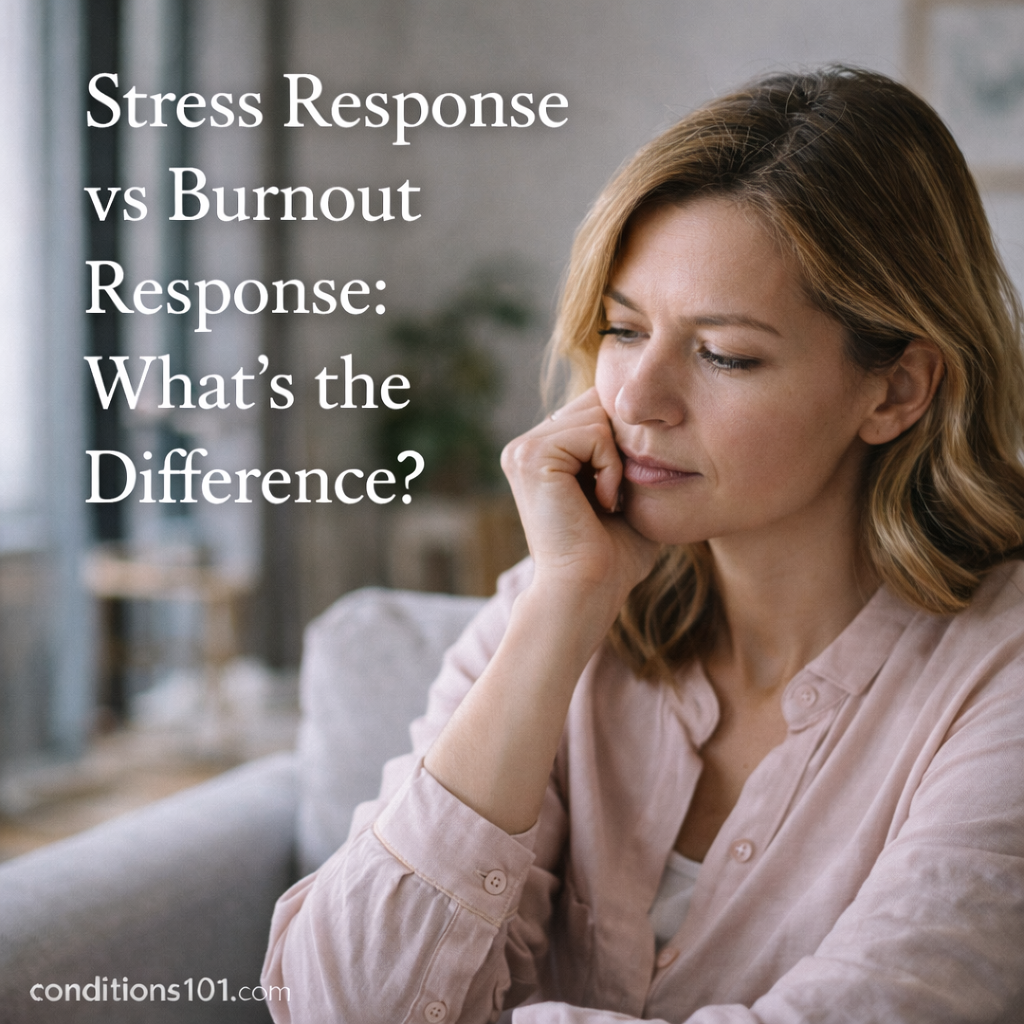
Stress response and burnout response are terms used to describe how the mind and body react to ongoing demands, pressure, or overload. While they are related, they are not the same experience. Understanding the difference helps clarify why short-term stress can feel manageable, while burnout often feels deeper and harder to recover from.
Neither term is a diagnosis. Both are descriptive concepts commonly used in psychology, workplace discussions, and general health education.
Understanding the Stress Response
A stress response is the body’s immediate or short-term reaction to a perceived challenge or demand. It is a natural and normal part of daily life.
Stress responses are designed to help a person adapt, respond, and perform when faced with pressure.
Common Features of a Stress Response
A stress response may include:
- Heightened alertness or focus
- Increased energy or urgency
- Temporary tension or restlessness
- Faster thinking or decision-making
- A feeling of being “on edge”
Stress responses are typically situational and tend to ease once the stressor is reduced or removed.
Understanding the Burnout Response
A burnout response develops after prolonged, unrelieved stress, especially when recovery time is limited. Instead of heightened energy, burnout is often associated with depletion.
Burnout reflects what happens when coping systems are overwhelmed over time.
Common Features of a Burnout Response
A burnout response may involve:
- Emotional exhaustion or numbness
- Reduced motivation or engagement
- Mental fatigue and difficulty concentrating
- Feeling detached, cynical, or indifferent
- A sense of being drained rather than pressured
Unlike stress, burnout does not usually resolve quickly with short breaks or rest.
Key Differences Between Stress Response and Burnout Response
Duration
- Stress response: Short-term or episodic
- Burnout response: Long-term and cumulative
Energy Levels
- Stress response: Often involves increased or restless energy
- Burnout response: Involves low energy and depletion
Emotional Experience
- Stress response: Anxiety, urgency, or tension
- Burnout response: Emotional flatness, detachment, or exhaustion
Motivation
- Stress response: Motivation may remain intact or increase temporarily
- Burnout response: Motivation is often reduced or absent
Stress Can Exist Without Burnout
Experiencing stress does not automatically lead to burnout. Many people encounter stress regularly and recover once demands decrease or balance is restored.
Stress becomes more likely to shift toward burnout when:
- Pressure is constant
- Recovery time is limited
- Demands feel uncontrollable or unending
- Effort outweighs perceived reward or meaning
Burnout Is Not Just “Extreme Stress”
Although burnout is linked to stress, it is qualitatively different. Stress is often described as “too much,” while burnout is often described as “nothing left.”
- Stress: “I have too much to do.”
- Burnout: “I don’t have anything left to give.”
This distinction helps explain why burnout can feel harder to recover from than stress alone.
How Each Response Affects Daily Life

Effects of a Stress Response
Stress responses may affect daily life by:
- Increasing irritability or tension
- Disrupting sleep temporarily
- Causing short-term focus issues
- Creating pressure-driven productivity
These effects often improve with rest or resolution of the stressor.
Effects of a Burnout Response
Burnout responses may affect daily life by:
- Reducing interest in work or responsibilities
- Making routine tasks feel overwhelming
- Lowering emotional engagement
- Increasing mental fatigue throughout the day
Recovery often requires longer-term changes rather than quick fixes.
Stress and Burnout Can Overlap
It is possible to experience stress and burnout at the same time. For example, a person may feel stressed by daily demands while also feeling emotionally exhausted from long-term overload.
The overlap can make it harder to recognize burnout, especially when stress has been present for a long time.
Why the Comparison Matters
Understanding the difference between stress response and burnout response helps with:
- Identifying what type of strain is being experienced
- Setting realistic expectations for recovery
- Choosing appropriate support or adjustments
- Avoiding self-blame for feeling depleted
Using the right language can clarify the experience without assigning labels or diagnoses.
Stress Response vs Burnout Response at a Glance
- Stress response is short-term and reactive
- Burnout response is long-term and depleting
- Stress often increases energy and urgency
- Burnout reduces energy, motivation, and engagement
- Stress may resolve quickly; burnout usually does not
Key Takeaways
- Stress response and burnout response are related but different experiences.
- Stress is a short-term reaction to pressure.
- Burnout develops from prolonged, unrelieved stress.
- Burnout involves exhaustion rather than urgency.
- Understanding the difference helps explain why recovery needs vary.